

You step out of your house on a -30°C morning, clutching your medical bag close to your body, wondering if those few seconds of exposure just ruined your month’s supply of medication. It’s a common worry for many of the 3.8 million Canadians living with diabetes. We understand how stressful it is to manage a life-saving treatment that feels as fragile as glass. Whether you’re dealing with a summer heatwave or a prairie winter, the fear that your expensive insulin has spoiled can lead to real anxiety about blood sugar spikes and ineffective doses.
Our team is here to replace that uncertainty with absolute confidence. This insulin storage guide for Canadian patients was designed to give you a clear, professional roadmap for medication safety in 2026. We’ll show you exactly how to master temperature control for different brands and provide a practical “cheat sheet” for storage timelines. You’ll also find neighborly advice on maintaining the cold chain while traveling across Canada and updates on how the national Pharmacare Act helps cover these essential costs. Let’s make sure your insulin stays as effective as the day you picked it up from our pharmacy.
Key Takeaways
- Understand the importance of the “cold chain” and why keeping unopened insulin between 2°C and 8°C is essential for its potency.
- Use this insulin storage guide for Canadian patients to safeguard your supply against the unique challenges of Manitoba’s freezing winters and humid summers.
- Master the different storage timelines for vials and pens to ensure your medication remains safe for use after it’s been opened.
- Learn to recognize the physical signs of spoiled insulin and understand why medication that has reached the freezing point must be discarded.
- Discover how a professional diabetes medication review can simplify your daily routine and help you manage your health with confidence.
Understanding the Insulin Cold Chain: Why Storage Matters
Insulin is more than just a liquid in a vial. It is a biological hormone, and like many things found in nature, it is delicate. When you follow an insulin storage guide for Canadian patients, you are protecting the structural integrity of a complex protein. If this protein is exposed to extreme temperatures or bright light, it begins to break down. This process makes the medication less effective, which can lead to frustrating and unexplained high blood sugar levels. When your insulin isn’t working at full strength, you might experience persistent hyperglycemia despite following your usual routine.
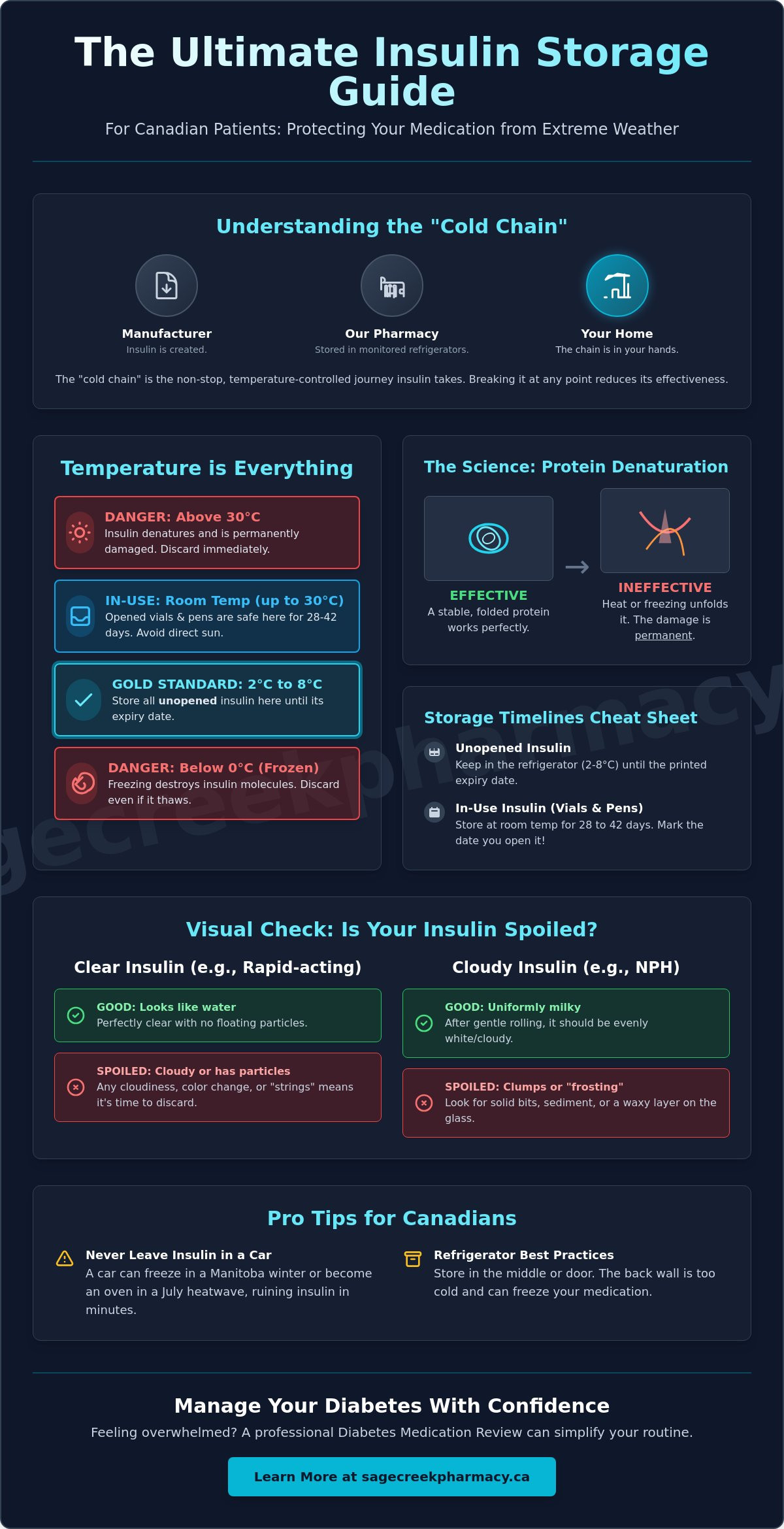
We often talk about the “cold chain” in our pharmacy. This term describes the constant, temperature-controlled journey your insulin takes from the manufacturer to our refrigerator, and finally to your home. If this chain breaks at any point, the medicine starts to lose its power. Using Insulin as a Medication requires a commitment to maintaining this environment to ensure every unit you inject works exactly as your doctor intended. We take this responsibility seriously, ensuring our storage systems are monitored around the clock before the medication ever reaches your hands.
The Science of Protein Denaturation
Think of an insulin molecule like a tightly folded piece of origami. For it to work in your body, it must keep its specific shape. When insulin gets too hot, the heat causes that “origami” to unfold. Scientists call this denaturation. Once the molecule unfolds, it cannot be refolded by putting it back in the fridge. The damage is permanent. This is why a vial left in a hot car for an hour is no longer reliable, even if it feels cool to the touch later.
Preservatives are added to your insulin to keep it safe from bacteria once the vial or pen is opened. However, these preservatives only work for a limited time, usually between 28 and 42 days. After this window, the risk of contamination and protein breakdown increases significantly. This is why we always recommend marking your calendar the day you start a new vial. Even if there is medicine left in the container, its ability to lower your blood sugar safely has likely diminished.
Identifying Spoiled Insulin at a Glance
You can often tell if your medication has been compromised just by looking at it. Clear insulin should always look like water. If you notice a cloudy appearance, a change in color, or small particles floating inside, it is time to start a new vial. For those using cloudy insulins, the texture should be uniform after gentle rolling.
- Frosting: Look for a white, waxy sheen or “frost” on the inside of the glass that doesn’t disappear when you gently roll the vial.
- Clumping: In cloudy insulins like NPH, look for solid bits that stick to the bottom or sides of the glass.
- Sediment: Watch for any stringy material or flakes that don’t mix back in after gentle agitation.
Denatured insulin is medication that has lost its biological activity due to environmental stress. If you suspect your insulin has been exposed to high heat or freezing temperatures, please reach out to us so we can help you stay safe and provide a fresh supply.
Temperature Guidelines: Celsius Rules for Canadian Homes
Your refrigerator is the heart of your insulin’s longevity. For long-term storage of unopened supplies, we follow the “Gold Standard” range of 2°C to 8°C (36°F to 46°F). Maintaining this narrow window ensures the protein remains stable until the expiry date printed on the box. Once you’ve started a vial or pen, it’s considered “in-use.” At this stage, most insulin can safely stay at room temperature, typically up to 25°C or 30°C, depending on the brand. This insulin storage guide for Canadian patients is designed to help you manage these shifts without worry.
While we follow local health standards, the FDA Temperature Guidelines also emphasize that insulin loses potency quickly if it strays from these specific ranges. If your home gets particularly warm during a July heatwave, you might need to move your “in-use” pen back to a cooler spot. If you ever feel overwhelmed by these rules, a diabetes medication review in Winnipeg can help you organize your supply and clear up any confusion about your specific prescriptions.
Refrigerator Safety: Best Practices
Don’t just toss your insulin anywhere in the fridge. The back wall is often the coldest spot where items can accidentally freeze; once insulin freezes, it’s useless. We recommend using the butter compartment or a middle shelf. These areas provide a more consistent temperature and are shielded from the blast of the cooling element. It’s also a great idea to keep a dedicated fridge thermometer nearby to verify that 2°C to 8°C range. Always keep your vials and pens in their original cardboard boxes to protect them from light, which can also degrade the medication over time.
Room Temperature: What is “Too Hot” in Canada?
In a Canadian home, “room temperature” generally means keeping the medication below 25°C. This means you should avoid window sills where the sun can beat down on the glass, or kitchen counters near your toaster or stove. While the standard rule for most opened insulin is to discard it after 28 days, modern science has given us some exceptions. For example, Levemir and Toujeo are safe at room temperature for up to 42 days, while Tresiba can last up to 56 days. The table below outlines the room-temperature shelf life for common brands used in Canada.
| Insulin Brand | Room Temp Shelf Life (Opened) |
|---|---|
| Lantus / Humalog / NovoRapid | 28 Days |
| Levemir / Toujeo | 42 Days |
| Tresiba | 56 Days |
| Novolin N / Humulin N | 14 Days |
Storage Rules for Different Delivery Devices
While the basic principles of the cold chain apply to everyone, the specific device you use changes your day-to-day handling rules. Vials are the steady workhorses of diabetes management. As long as they remain unopened, they can sit comfortably in your refrigerator’s middle shelf until the date stamped on the box. Once you transition to using a pen or loading a cartridge, the clock starts ticking differently. This insulin storage guide for Canadian patients helps you distinguish between these methods so you don’t accidentally waste expensive medication or compromise your comfort.
According to Insulin Storage Guidance provided by the NIH, the mechanical parts of delivery devices and the preservatives inside the medication react specifically to environmental changes. We often see patients who are confused because their vial instructions differ from their pen instructions. If you’re ever unsure about the specific countdown for your brand, our team is always available for a diabetes medication review in Winnipeg to help you stay organized.
Insulin Pens: The “No-Fridge” Rule After Opening
We often tell our neighbors: once you click that pen and take your first dose, keep it out of the fridge. Injecting cold insulin can be quite painful and often leads to localized skin irritation or “stings” at the injection site. Keeping your in-use pen at room temperature makes the process much more comfortable. There is also a practical physics reason for this. Moving a pen back and forth between a cold fridge and a warm room can cause air bubbles to form inside the cartridge, which may lead to inaccurate dosing. Always remember to twist off and dispose of the needle after every use. Leaving a needle attached creates an open gateway for air to enter and medication to leak out.
Pump Users: Body Heat and Stability
Pump therapy brings a unique set of challenges because the reservoir sits very close to your body. Your natural body temperature, which is roughly 37°C, is significantly higher than the recommended storage limit for insulin. This constant warmth accelerates the breakdown of the protein molecules. This is why pump reservoirs and infusion sets are typically changed every 2 to 3 days, even if you still have plenty of insulin left in the tank. If the insulin begins to degrade due to heat, it can become “sticky” and lead to occlusion alarms on your pump. These blockages aren’t just annoying; they stop your insulin delivery entirely, which can lead to a rapid rise in blood sugar levels. Regular changes are the best way to ensure your pump remains a reliable partner in your care.
Canadian Climate Challenges: Winter Freezes and Summer Heat
Living in Manitoba means preparing for temperature swings that would surprise most people. While many global resources focus on protecting medication from tropical heat, this insulin storage guide for Canadian patients must prioritize our unique reality: the deep freeze. In Winnipeg, the “Winter Car Danger” is a very real threat to your health. Insulin freezes at 0°C, and once those delicate proteins turn to ice, the medication is useless. Even if it thaws out later, the molecular structure has been destroyed. You should never use insulin that has been frozen or looks “slushy” in the vial.
Summer presents the opposite challenge. Whether you are heading to the lake or driving across the prairies, a car interior can exceed 30°C in minutes. During a power outage at home, a closed refrigerator will typically maintain a safe temperature for about four hours. If the outage lasts longer, you’ll need to move your supply to a cooler with ice packs, ensuring the vials don’t touch the ice directly to avoid accidental freezing. When you’re flying, always keep your insulin in your carry-on luggage. The cargo hold of an airplane is not climate-controlled and can reach temperatures that will ruin your entire supply before you even land.
Protecting Insulin from the Winnipeg Winter
We’ve seen how quickly a quick stop at the grocery store can turn into a problem if you leave your “in-use” pen in a parked car. On a -20°C day, your medication can freeze in less time than it takes to buy a carton of milk. If you’re out for a walk or waiting for the bus, keep your pen in an inside coat pocket. Your own body heat is the most reliable heater you have for keeping that medication within a safe range. If you suspect your insulin has been exposed to the cold for too long, look for “frosting” or clumps that don’t dissolve. If you see these signs, please don’t take the risk; start a fresh vial immediately.
Travel Kits and Cooling Pouches
For summer road trips, we often recommend evaporative cooling pouches, such as Frio bags. Unlike standard ice packs, which can actually get too cold and freeze the insulin they touch, these pouches use water evaporation to keep medication at a steady, safe temperature. Before you head out on a long-term trip or an international vacation, it is a great idea to schedule a medication review. We can help you calculate exactly how much supply you’ll need and provide tips for crossing the border with your supplies. To ensure your insulin arrives at your home safely regardless of the weather, you can always rely on our free medication delivery in Winnipeg.
How Sage Creek Pharmacy Supports Your Diabetes Management
We believe that managing a chronic condition should never feel like a solo journey. With approximately 3.8 million Canadians living with diabetes, our team at Sage Creek Pharmacy is dedicated to being more than just a place to pick up your prescriptions. This insulin storage guide for Canadian patients serves as a foundation, but we know that your individual needs are unique. Whether you’re navigating the nuances of the 2026 Pharmacare Act (Bill C-64) or need help understanding how to transfer your prescription in Manitoba, we’re here to provide clear, compassionate guidance that prioritizes your safety.
Our delivery service is specifically designed to protect the integrity of your medication. We offer free medication delivery in Winnipeg, using temperature-controlled packaging to ensure your insulin never enters the “danger zone” during transit. Our drivers are trained to prioritize these shipments, minimizing “porch time” so your medication goes directly from our climate-controlled environment to yours. We also stock a variety of cooling accessories, from Frio pouches to hard-shell travel cases, helping you maintain the cold chain during every Manitoba road trip or summer vacation.
Winnipeg’s Partner in Diabetes Care
Our pharmacists provide personalized diabetes medication reviews in Winnipeg to ensure your regimen is working effectively. These sessions are the perfect time to discuss your home storage setup or ask about transitioning safely between insulin types, especially with 2026 product changes like the discontinuation of Humulin R. Having a local pharmacist who knows your specific health history means you get tailored advice that a large corporate entity simply cannot provide. We invite you to visit us in Sage Creek for a one-on-one consultation where we can review your storage habits and answer any questions about Manitoba Pharmacare coverage and deductible limits.
Convenient Refills and Reliable Delivery
Staying ahead of your supply is the best way to avoid the stress of an emergency refill. You can use our online prescription refill system to request your medication from the comfort of your home. To make life even simpler, we offer medication reminders and can help you coordinate your refills so they arrive on a predictable schedule. If you ever find yourself in a bind, we also provide professional guidance on how to get an emergency prescription refill in Winnipeg. We’re committed to ensuring you never have to worry about the safety or availability of your life-saving medication. Reach out to us today to see how we can support your wellness goals.
Protecting Your Health in Every Season
Managing diabetes in our climate requires vigilance, but it doesn’t have to be a source of constant stress. By keeping your unopened supplies between 2°C and 8°C and protecting your in-use pens from the harsh Winnipeg winter, you ensure your medication remains a reliable tool for your health. We hope this insulin storage guide for Canadian patients provides the clarity you need to handle your supplies with confidence; whether you’re at home or traveling across the country. Remember that once insulin has frozen or exceeded its room-temperature timeline, it is no longer effective for managing your blood sugar.
Our team of experienced clinical pharmacists is here to support you every step of the way. As a community-focused independent pharmacy, we take pride in offering personalized care that large chains often overlook. Whether you need free city-wide prescription delivery to keep your medication safe during transport or advice on Manitoba Pharmacare, we’re ready to help. Please Book a Free Diabetes Medication Review with Our Winnipeg Team today to discuss your specific needs. Your safety is our priority, and we’re honored to be your partner in wellness.
Frequently Asked Questions
Can I still use insulin if it was accidentally frozen?
No, you must discard any insulin that has been frozen. Even if the medication thaws out and looks normal, the freezing process at 0°C or below permanently destroys the protein structure of the hormone. Using “slushed” or frozen insulin will result in unpredictable blood sugar levels because the medication has lost its biological potency. If you are unsure if your vial reached freezing temperatures in your car or fridge, it is always safer to start a fresh one.
How long is insulin good for at room temperature in Canada?
Most insulin brands are safe to use for 28 days once kept at room temperature, which we define as being below 25°C. However, this insulin storage guide for Canadian patients highlights several important exceptions. For instance, Levemir and Toujeo can last up to 42 days, while Tresiba is stable for up to 56 days. Conversely, certain NPH or pre-mixed insulins may only be stable for 10 to 14 days. Always check your specific brand’s insert or ask our team to clarify your timeline.
What is the best place in the refrigerator to store my insulin vials?
The middle shelf or the butter compartment in the door are the most reliable spots for your supply. You should avoid the very back of the refrigerator because it is often the coldest area and poses a high risk of accidental freezing. Likewise, avoid placing vials directly under the cooling vent. Keeping your insulin in its original box also provides an extra layer of insulation and protects the medication from light exposure every time the fridge door opens.
Does unopened insulin really last until the expiry date on the box?
Yes, unopened insulin will remain effective until the manufacturer’s expiry date as long as the cold chain has never been broken. This requires the medication to be stored consistently between 2°C and 8°C. If your supply has been exposed to extreme heat or cold at any point before that date, the expiry date no longer applies. We monitor our pharmacy refrigerators around the clock to ensure the supply you receive from us starts with the highest level of integrity.
Can I use a cooling pouch if I am traveling through a hot climate?
Yes, we highly recommend using an evaporative cooling pouch, like a Frio bag, for travel in temperatures above 25°C. These pouches are often better than traditional ice packs because they maintain a steady, cool temperature without the risk of freezing the insulin. If you do use a standard cooler with ice, wrap your insulin in a hand towel so it never makes direct contact with the ice. This simple step prevents the medication from getting too cold during your trip.
Why does my insulin look cloudy or have white flakes in it?
Cloudiness in a medication that is supposed to be clear is a definitive sign of spoilage or bacterial contamination. If you see white flakes, “frosting” on the glass, or clumps that won’t dissolve when you gently roll the vial, the insulin has likely denatured. This often happens after exposure to extreme temperatures or vibration. For cloudy insulins like NPH, the liquid should look uniform after rolling; if you see solid “clots” or stringy bits, you should discard the vial immediately.
What should I do with my insulin during a long power outage?
Keep your refrigerator door closed as much as possible to trap the cold air, which typically lasts for about four hours. If the outage lasts longer, move your insulin to a small insulated cooler with a cold pack, ensuring the medication is shielded from direct contact with the cold source. Do not put your insulin in a snowbank during a winter power outage, as the temperature is too inconsistent and will likely freeze your supply. Our team can help you assess your supply once power returns.
How do I safely dispose of expired or spoiled insulin in Winnipeg?
You should bring any expired or spoiled insulin vials and pens directly to our pharmacy in Sage Creek for safe disposal. We participate in provincial take-back programs to ensure medications don’t end up in the landfill or water system. For needles and lancets, please use a puncture-resistant sharps container. If you don’t have one, we can provide you with a proper yellow sharps bin and show you how to return it to us once it is full. This helps keep our community and sanitation workers safe.