
Most people think of folic acid as a vitamin strictly for pregnant women. That’s a reasonable assumption, but it’s only part of the story. This essential B vitamin plays a role in nearly every cell in your body, which means its importance doesn’t begin at conception or end after delivery.
If you’ve ever stood in the supplement aisle wondering whether you actually need a folic acid supplement, or felt confused about the difference between folate and folic acid, you’re not alone. These are questions our pharmacy team hears from Winnipeg families regularly, and they deserve a clear, honest answer.
In this guide, we’ll walk you through exactly what folic acid does in the body, who genuinely benefits from supplementation, how to recognize a deficiency, and what the right dosage looks like at different life stages. Whether you’re planning a pregnancy, managing a chronic condition, or simply trying to make smarter choices about your daily supplements, this guide will give you the grounded, practical information you need to move forward with confidence.
Key Takeaways
- Folic acid and folate are not the same thing — understanding the difference helps you choose the right supplement form for your specific health needs.
- This essential B vitamin supports far more than pregnancy, playing a critical role in DNA synthesis, cellular repair, and long-term heart wellness.
- Health Canada recommends supplementation even for unplanned pregnancies, and the reasons why may surprise you.
- Daily dosage recommendations vary significantly depending on your life stage, and getting the amount right matters more than most people realize.
- Your local Winnipeg pharmacist can help you navigate supplement choices safely — no appointment necessary to get personalized, expert guidance.
What is Folic Acid and Why Does Your Body Need It?
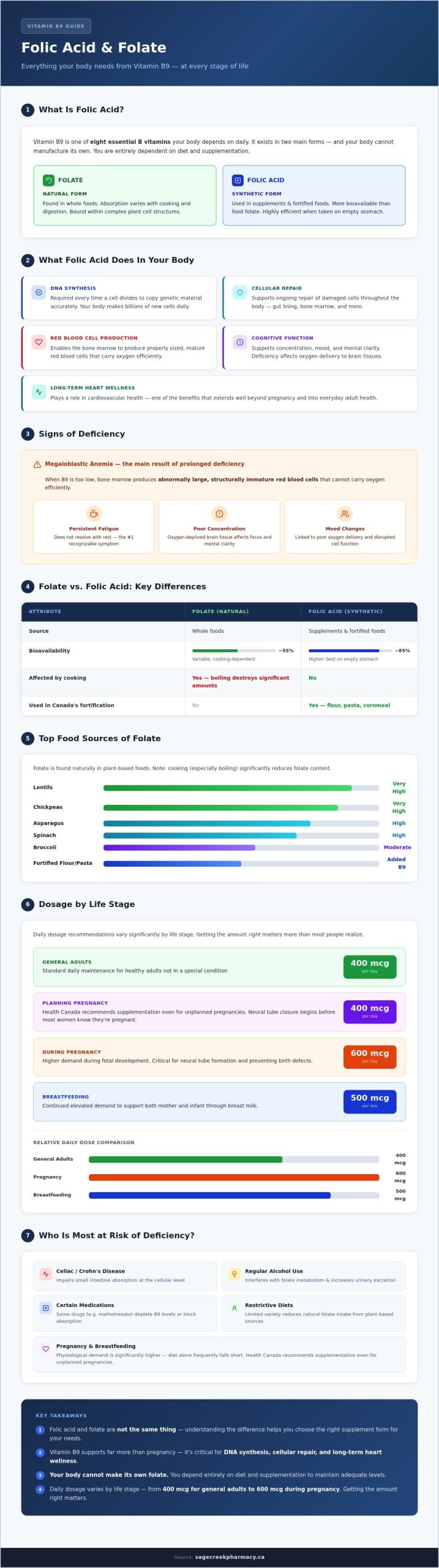
Vitamin B9 is one of the eight essential B vitamins your body depends on daily. It exists in two main forms: folate, the naturally occurring version found in food, and folic acid, the synthetic form used in supplements and fortified products. Both forms serve the same fundamental purpose, but your body processes them differently, which matters when you’re choosing a supplement. We’ll explore that distinction further in a later section.
At its core, this nutrient is involved in two of the most critical processes happening inside you right now: DNA synthesis and cellular repair. Every time a cell divides, your body needs folate to copy genetic material accurately and build new cells. Without adequate levels, that process becomes error-prone. Given that your body produces billions of new cells every day, from the lining of your gut to the tissues in your bone marrow, the stakes are genuinely high.
Here’s the part that surprises most people: your body cannot manufacture its own folate. Zero. You are entirely dependent on what you eat and, when diet falls short, what you supplement. That dependency makes B9 one of the nutrients most vulnerable to deficiency, particularly among people with restrictive diets, absorption issues, or higher physiological demands.
The Science of Red Blood Cells and Energy
One of folic acid’s most visible roles is supporting healthy red blood cell production. When B9 levels drop too low, the bone marrow begins producing red blood cells that are abnormally large and structurally immature, a condition called megaloblastic anemia. These oversized cells can’t carry oxygen efficiently, which is why the defining symptom most people notice first is persistent, unexplained fatigue that doesn’t resolve with rest.
The connection between B9 levels and everyday cognitive function is equally important. Oxygen-deprived tissues don’t just make you tired; they affect concentration, mood, and mental clarity. Folate deficiency is a state in which the body lacks sufficient Vitamin B9 to support normal cell production and function, with fatigue as its most common and recognizable symptom.
Neighborly Care: Why Sage Creek Pharmacy Prioritizes Nutrition
At Sage Creek Pharmacy, we believe that filling a prescription is only one small part of what genuine healthcare looks like. Nutritional wellness, including understanding which supplements actually serve your needs, is something our pharmacy team takes seriously. If you’ve been feeling consistently run down or foggy, that’s worth a conversation, not just a guess at the supplement aisle.
Our Personal Health Consultations are a practical starting point for Winnipeg families who want straightforward, personalized guidance on nutrition and supplementation. No referral needed. Just a team that knows your health matters beyond the prescription counter.
Folic Acid vs. Folate: Understanding the Difference
The terms are often used interchangeably on supplement labels and health websites, but folate and folic acid are chemically distinct compounds. Folate is the naturally occurring form of Vitamin B9, found in foods like spinach, asparagus, lentils, chickpeas, and broccoli. Your body absorbs it directly from the digestive tract, but the amount you actually retain depends heavily on how the food is prepared. Cooking, particularly boiling, can destroy a significant portion of the folate content before it ever reaches your small intestine.
Folic acid, by contrast, is the synthetic, oxidized form of B9 used in supplements and added to fortified foods. In Canada, Health Canada mandates that white flour, pasta, and enriched cornmeal be fortified with folic acid, making it a quiet but consistent presence in many everyday staples. This fortification policy was introduced specifically because dietary folate alone proved insufficient for population-level needs.
Bioavailability and Absorption
Here’s where the science gets genuinely useful. Folic acid is actually more bioavailable than food-based folate under most conditions, meaning your body can absorb and use a higher proportion of what you consume. When taken on an empty stomach, folic acid absorption is particularly efficient. Food folate, by comparison, is bound within complex plant cell structures that require additional digestive steps to unlock.
That said, several factors can undermine B9 absorption regardless of the form you’re getting:
- Gut health issues: Conditions like celiac disease or Crohn’s disease can impair the small intestine’s ability to absorb B9 at the cellular level.
- Regular alcohol consumption: Alcohol interferes with folate metabolism and increases urinary excretion of the nutrient.
- Certain medications: Some drugs, including methotrexate and certain anticonvulsants, directly disrupt how the body processes B9.
This is why a diet full of leafy greens doesn’t automatically guarantee adequate B9 status. Absorption is the variable that most people overlook.
Choosing the Right Supplement for Your Lifestyle
Not all B9 supplements are equivalent. A standard multivitamin may contain a modest amount of folic acid, but a dedicated tablet gives you more precise control over your dosage. When comparing products, look for the amount listed in mcg DFE, which stands for Dietary Folate Equivalents. This standardized unit accounts for the difference in bioavailability between synthetic and natural forms, making label comparisons more meaningful.
Selecting a quality supplement is easier with a knowledgeable set of eyes on the label. Our pharmacy team at Sage Creek regularly helps Winnipeg families sort through the options available in over-the-counter medications, pointing out which products offer genuine value and which are simply well-marketed. If you’re unsure where to start, that conversation costs you nothing and could save you months of guesswork.
Folic Acid for Pregnancy and Beyond: Key Benefits
Ask most people what folic acid is for, and they’ll say pregnancy. They’re not wrong, but they’re only seeing a fraction of the picture. This vitamin’s role in human health extends well past the prenatal stage, and understanding the full scope of what it does changes how seriously you take your own B9 status, regardless of whether a pregnancy is on your horizon.
Prevention of Neural Tube Defects (NTDs)
Neural tube defects are among the most serious and preventable birth complications. The neural tube is the embryonic structure that develops into the brain and spinal cord. When it doesn’t close properly during early development, the result can be spina bifida, a condition where the spinal cord remains partially exposed, or anencephaly, a fatal condition in which major portions of the brain fail to form at all.
Here’s the detail that catches most people off guard: the neural tube closes within the first 28 days of pregnancy, often before a person even knows they’re pregnant. By the time a positive test appears, that critical window has already passed.
This is precisely why Health Canada recommends that anyone who could become pregnant begin taking a daily folic acid supplement at least three months before conception. Waiting until pregnancy is confirmed is simply too late for NTD prevention. Since nearly half of pregnancies in Canada are unplanned, this recommendation applies broadly, not just to those actively trying to conceive. A consistent daily supplement habit eliminates the timing risk entirely.
Heart Health and Homocysteine
Beyond pregnancy, one of B9’s most clinically significant roles involves cardiovascular protection. Folic acid works alongside Vitamin B12 to regulate homocysteine, an amino acid that accumulates in the blood when B vitamin levels are insufficient. Elevated homocysteine is associated with increased risk of arterial damage, blood clots, and stroke.
The relationship between these two B vitamins is genuinely synergistic. B9 helps convert homocysteine into methionine, a harmless amino acid the body can use constructively. Without adequate B12 to support that conversion pathway, B9 alone can’t complete the job. If you’re managing cardiovascular risk factors, understanding this partnership matters. Our Vitamin B12 guide explores this synergy in detail and is worth reading alongside this one.
Emerging Research on Mental Health
The connection between B9 and mental wellness is an active area of research. Low folate levels have been observed in some individuals experiencing depression, and certain studies suggest that adequate B9 status may support the effectiveness of antidepressant treatment. The proposed mechanism involves folate’s role in synthesizing neurotransmitters, including serotonin and dopamine. This research is still developing, and B9 supplementation isn’t a standalone treatment for depression. However, it’s a meaningful reason to take your overall B vitamin status seriously, particularly if mood and cognitive health are concerns you’re already managing with your healthcare team.
If any of these benefits prompt questions about your own supplement routine, our pharmacy team at Sage Creek is a straightforward resource. A quick conversation can clarify whether your current approach is actually covering your needs.
Dosage, Food Sources, and Safety: How Much is Right for You?
Getting the dose right matters more than most supplement labels suggest. For the average healthy adult, Health Canada’s recommended daily intake of folic acid sits at 400 mcg DFE. That number climbs considerably during pregnancy, where 600 to 800 mcg daily is the standard recommendation, reflecting the dramatically increased cellular demands of fetal development. Women who have previously had a pregnancy affected by a neural tube defect may be advised to take significantly higher doses under medical supervision.
Breastfeeding individuals have their own distinct target, generally around 500 mcg daily. These aren’t arbitrary numbers. They’re calibrated to the specific physiological load your body is carrying at each stage of life, which is why a one-size-fits-all approach to B9 supplementation rarely serves anyone well.
Recognizing Folate Deficiency
Deficiency doesn’t always announce itself dramatically. Some of the most telling signs are easy to dismiss or attribute to other causes. Watch for:
- Persistent mouth sores or ulcers that don’t heal at a normal pace
- A swollen, inflamed tongue (glossitis), sometimes described as a smooth, painful appearance
- Premature grey hair, which in some cases has been linked to B vitamin insufficiency
- Unexplained fatigue and difficulty concentrating, as discussed in the red blood cell section earlier
- Tingling or numbness in the hands and feet, particularly when B12 deficiency is also present
If several of these symptoms are familiar, it’s worth having a conversation with a pharmacist before self-diagnosing or reaching for a high-dose supplement on your own. You can also find helpful information on distinguishing nutritional ulcers from other conditions, like cold sores, through resources provided by Ballyduff Pharmacy.
Safety and High-Dose Risks
Folic acid is water-soluble, so excess amounts are generally excreted rather than stored. That said, taking very high doses, typically above 1,000 mcg daily without medical guidance, carries a specific concern: it can mask a Vitamin B12 deficiency by correcting the anemia while leaving neurological damage to progress silently. This is a clinically meaningful risk, not a theoretical one, especially for older adults whose B12 absorption naturally declines with age.
Medication Interactions to Discuss with Your Pharmacist
This is the area where most generic health content falls short, and where Winnipeg residents managing complex medication routines deserve clearer information. Several commonly prescribed drugs interact directly with how your body processes B9:
- Anti-seizure medications such as phenytoin and valproate can lower folate levels and may also be affected by supplementation in return, altering their therapeutic concentration in the blood.
- Methotrexate, used for rheumatoid arthritis and certain cancers, works partly by blocking folate metabolism. Supplementing without guidance can interfere with the drug’s intended action.
- Metformin, a first-line diabetes medication, has been shown in some research to reduce B12 absorption over time, which in turn affects the B9-B12 conversion pathway discussed earlier. If you’re managing diabetes with metformin, your B vitamin status deserves regular attention.
These interactions aren’t obscure edge cases. They affect real people managing real conditions right here in Winnipeg. A medication review with our pharmacy team is the most practical way to identify whether any of your current prescriptions are quietly working against your nutritional status, before a deficiency develops.
Natural Food Sources vs. Supplementation
Building your B9 intake through food is a genuinely good strategy, and most Winnipeg grocery stores carry everything you need. Folate-rich options to add to your regular rotation include:
- Spinach and romaine lettuce
- Asparagus and Brussels sprouts
- Lentils, chickpeas, and black beans
- Broccoli and avocado
- Fortified breakfast cereals and enriched pasta
- Sunflower seeds and orange juice
One practical note on preparation: boiling vegetables can destroy a substantial portion of their folate content. Steaming, roasting, or eating certain vegetables raw preserves significantly more. Lentils and beans, cooked in their own liquid, retain folate better than most other cooking methods.
Food sources are a solid foundation, but they’re rarely sufficient on their own when physiological demands are elevated, absorption is compromised, or dietary variety is limited. That’s the point at which a pharmacist-recommended supplement becomes a practical, targeted solution rather than an optional add-on.
If you’re unsure whether your current diet and supplement routine are covering your actual needs, our team at Sage Creek can walk you through it clearly. Book a medication review and let’s take the guesswork out of your B vitamin strategy together.
How Sage Creek Pharmacy Supports Your Nutritional Wellness
Knowing what folic acid does is one thing. Having a trusted, knowledgeable team to help you act on that knowledge is another. That’s where Sage Creek Pharmacy comes in, and it’s the part of the picture that no general health website can replicate.
Our approach to nutritional wellness isn’t transactional. When you come to us with questions about your B vitamin routine, whether you’re planning a pregnancy, managing a chronic condition, or simply trying to understand what’s actually in your current multivitamin, you get a real conversation with a pharmacist who knows your health history and takes your concerns seriously. That kind of personalized attention is genuinely hard to find at a large chain pharmacy where staff turnover is high and time is short.
We also recognize that supplement needs don’t exist in isolation. If you’re on a medication that quietly depletes your B9 levels, or if you’re taking multiple supplements without knowing how they interact, a brief review with our team can catch issues before they become problems. That’s not a sales pitch. It’s just good pharmacy practice.
Convenient Online Refills and Delivery
Consistency is everything when it comes to supplementation. Running out of a daily vitamin for a week here and there adds up quickly, especially during pregnancy or when you’re actively managing a deficiency. Our online prescription refill service makes staying stocked genuinely simple. Submit your refill request from home, and we’ll handle the rest.
For Winnipeg families who’d rather not make an extra trip, our free city-wide prescription delivery means your vitamins and medications come to you. No delivery fee, no minimum order threshold to hit. It’s one less logistical barrier between you and a consistent wellness routine.
Your Trusted Wellness Partner in Winnipeg
Independent pharmacies operate differently than corporate chains. We’re not managing hundreds of locations or answering to shareholders. Our focus is this community, specifically the families in Sage Creek and the surrounding Winnipeg neighbourhoods who trust us with their health decisions day in and day out.
That local focus means we notice things. We remember that you switched medications last spring. We know which supplements pair well with what you’re already taking. And we’re here, reliably, when you have a question that doesn’t quite warrant a doctor’s appointment but still deserves a thoughtful answer.
If today’s guide has raised questions about your own folic acid intake or your broader B vitamin strategy, don’t let those questions sit unanswered. Stop by the pharmacy, give us a call, or start with an online refill request. Our team is ready to help you build a supplement routine that actually fits your life.
Your Next Step Toward Better Nutritional Health
Folic acid does far more than support pregnancy. From keeping your red blood cells healthy to protecting your heart and supporting cognitive function, it’s a nutrient your body genuinely depends on every single day. Getting the right form, the right dose, and the right timing matters, and those details look different for everyone depending on their age, medications, and health history.
That’s exactly where a local, independent pharmacy makes a real difference. At Sage Creek Pharmacy, our team can review your current supplement routine, flag any medication interactions worth watching, and help you build a B vitamin strategy that actually fits your life. We offer free city-wide delivery in Winnipeg, so staying consistent with your supplements has never been more straightforward.
You don’t need to figure this out alone, and you don’t need an appointment to start a conversation. Transfer your prescriptions to Sage Creek Pharmacy today and experience personalized care from a team that genuinely knows your name. Your wellness is worth that kind of attention.
Frequently Asked Questions About Folic Acid
Can I get enough folic acid from my diet alone?
For most healthy adults with varied diets, food sources can cover baseline needs, but it’s genuinely difficult to confirm without knowing your absorption capacity. Cooking methods, gut health, and dietary restrictions all affect how much folate your body actually retains from vegetables and legumes. People with elevated physiological demands, such as those who are pregnant, breastfeeding, or managing a chronic condition, almost always need supplementation to reliably meet their targets.
What is the best time of day to take a folic acid supplement?
Folic acid absorbs most efficiently on an empty stomach, so taking it first thing in the morning works well for most people. That said, if you experience any digestive discomfort, taking it with a light meal is a reasonable alternative. Consistency matters more than timing. Taking it at the same point in your daily routine, whether morning or evening, makes it far easier to maintain the habit without gaps.
Is there a difference between folic acid and methylfolate?
Yes, and it’s a clinically meaningful one. Methylfolate is the active, metabolically ready form of Vitamin B9 that your body can use immediately, without any conversion steps. Folic acid, the standard synthetic form, requires your body to convert it through a multi-step process. Some people carry a genetic variant called MTHFR that reduces their ability to complete that conversion efficiently, making methylfolate a more practical supplement choice for them. If you suspect this applies to you, a pharmacist can help you evaluate your options.
Can men benefit from taking folic acid supplements?
Absolutely. Folic acid supports DNA synthesis, red blood cell production, and cardiovascular health in everyone, regardless of sex. For men specifically, some research has explored a potential connection between folate status and sperm DNA integrity, though this area is still developing. Men managing heart health, fatigue, or conditions that affect nutrient absorption have clear, practical reasons to pay attention to their B9 levels, just as women do.
What happens if I take too much folic acid?
Folic acid is water-soluble, so your body excretes excess amounts rather than storing them. The primary risk with high doses, generally above 1,000 mcg daily, is that it can mask a Vitamin B12 deficiency by correcting the blood-related symptoms while neurological damage continues undetected. This is a particular concern for older adults, whose B12 absorption naturally declines with age. Staying within recommended amounts and discussing higher doses with a pharmacist is the safest approach.
How does folic acid interact with my other prescriptions?
Several common medications affect how your body processes folic acid, and the interaction runs in both directions. Anti-seizure drugs, methotrexate, and certain antibiotics can deplete B9 levels or interfere with its metabolism. In some cases, supplementing while on these medications can also alter the drug’s effectiveness. If you’re managing multiple prescriptions, a medication review with our pharmacy team at Sage Creek is the most reliable way to identify any interactions before they become a problem.
Does Sage Creek Pharmacy deliver supplements for free in Winnipeg?
Yes. Sage Creek Pharmacy offers free city-wide prescription delivery across Winnipeg, which includes vitamins and supplements alongside prescription medications. There’s no delivery fee and no minimum order requirement. If staying consistently stocked on your daily folic acid supplement has been a logistical challenge, our delivery service removes that barrier entirely. You can submit a refill request online and have your order brought directly to your door.
How long does it take to correct a folate deficiency?
With consistent daily supplementation at appropriate doses, most people begin to see measurable improvement in their folate blood levels within two to three weeks. Full correction of a moderate deficiency, including resolution of symptoms like fatigue and mouth sores, typically takes one to three months. The timeline varies depending on the severity of the deficiency, any underlying absorption issues, and whether a contributing factor like a medication interaction has been addressed. A follow-up conversation with your pharmacist can help you track progress appropriately.